
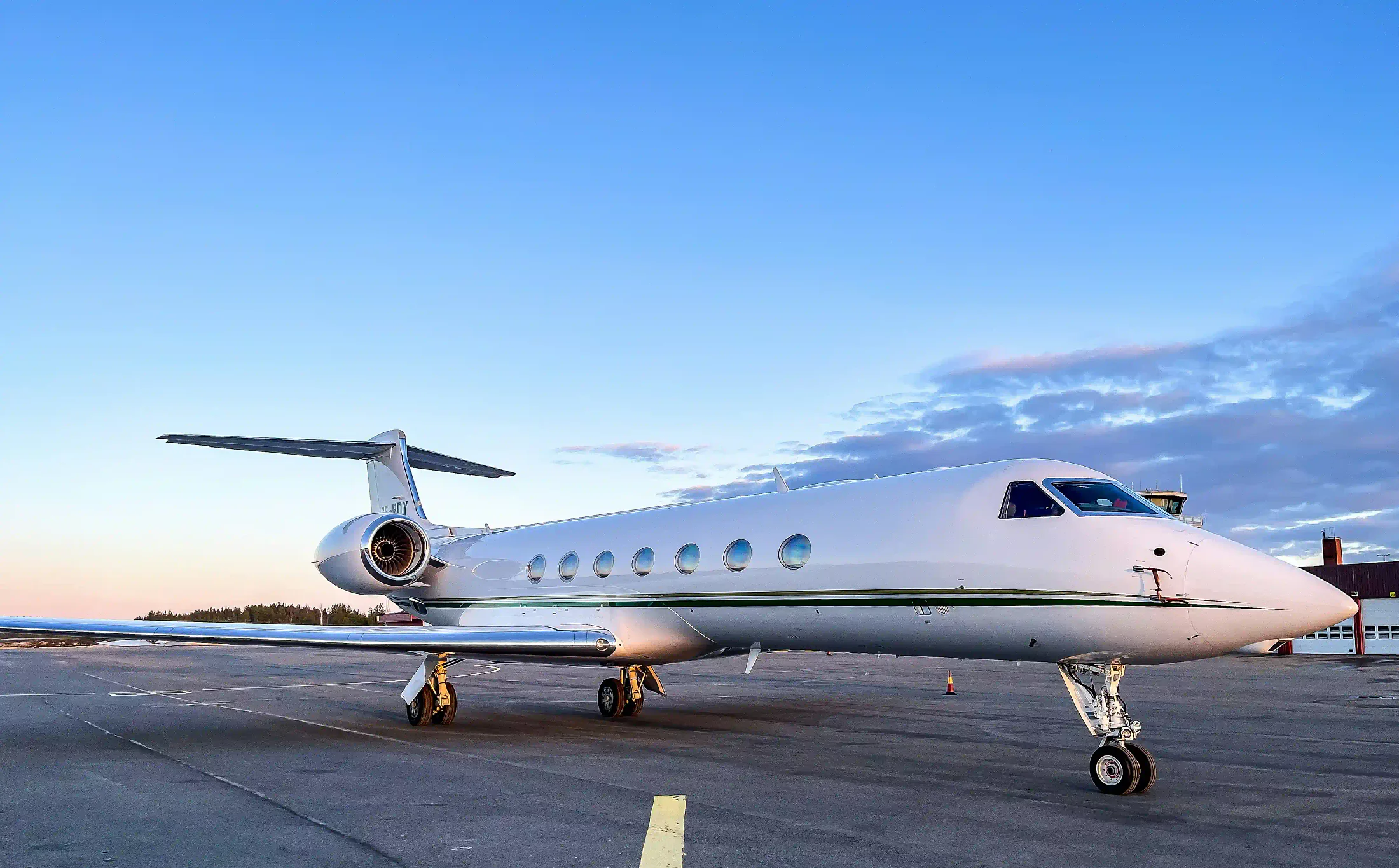
Search for private jet detailing and you will find everything from car wash crews with a step ladder to national franchises. The spread in quality is enormous, and from the ramp it is hard to tell who is who. Here is what professional jet detailing actually involves, so you know what to expect and what to ask for.
A jet is not a big car, and not a small airliner either
Jet paint systems, acrylic windows, polished leading edges and pneumatic sensors do not tolerate automotive products or pressure-washing habits. At the same time, a business jet is not an airline aircraft on a turnaround: it is a hand-finished asset whose owner sees every streak. Professional jet detailing sits in between: aviation-safe chemistry and OEM-conscious technique, applied to a standard set by the person in the left seat and the person in the cabin, not by a departure clock.
The exterior scope
A proper exterior detail covers far more than a wash. Degreasing along the belly and around the engine lines, bug removal from leading edges done by soak-and-lift rather than abrasion, brightwork brought to a true mirror where the aircraft carries bare metal, de-mineralized final rinsing so the black paint so common on today’s jets dries spotless, and protection, wax or a ceramic coating, that keeps the finish easy to maintain between visits. On a jet, gloss is not vanity: a clean, sealed surface is easier to inspect and sheds contamination that would otherwise etch in.
The interior scope
Jet cabins concentrate delicate materials in a small space: specialty leathers, suede or wool headliners, high-gloss veneers, plated hardware, galley stone and glass. A professional interior detail treats each material with its own chemistry and its own touch, deep-cleans the carpet with extraction rather than surface shampoo alone, services the lavatory and galley to a hygienic standard, and finishes the flight deck without touching what should not be touched. The result should read as new-aircraft neutral: no perfume masking, no shine products on grip surfaces, nothing slippery, nothing sticky.
Cadence is what separates sharp fleets from tired ones
Jets that look chartered-yesterday are on a schedule. Exterior maintenance washes keep contamination from bonding, interior refreshes ride between deep details, and the deep work, correction, coating, extraction, brightwork, lands on a calendar instead of a complaint. Flight departments that put detailing on a program spend less attention on it, not more: the aircraft simply stays at standard.
What to ask whoever details your jet
Are you insured for aviation work, and can you send the certificate? What products touch the paint, the windows and the boots, and are they approved for aircraft? Have you worked this type before? Do you come to our hangar, and can you work around our schedule? We answer all of those in one email, we are fully mobile across Arkansas, Oklahoma, Missouri and Kansas, and the jet never repositions for us.