
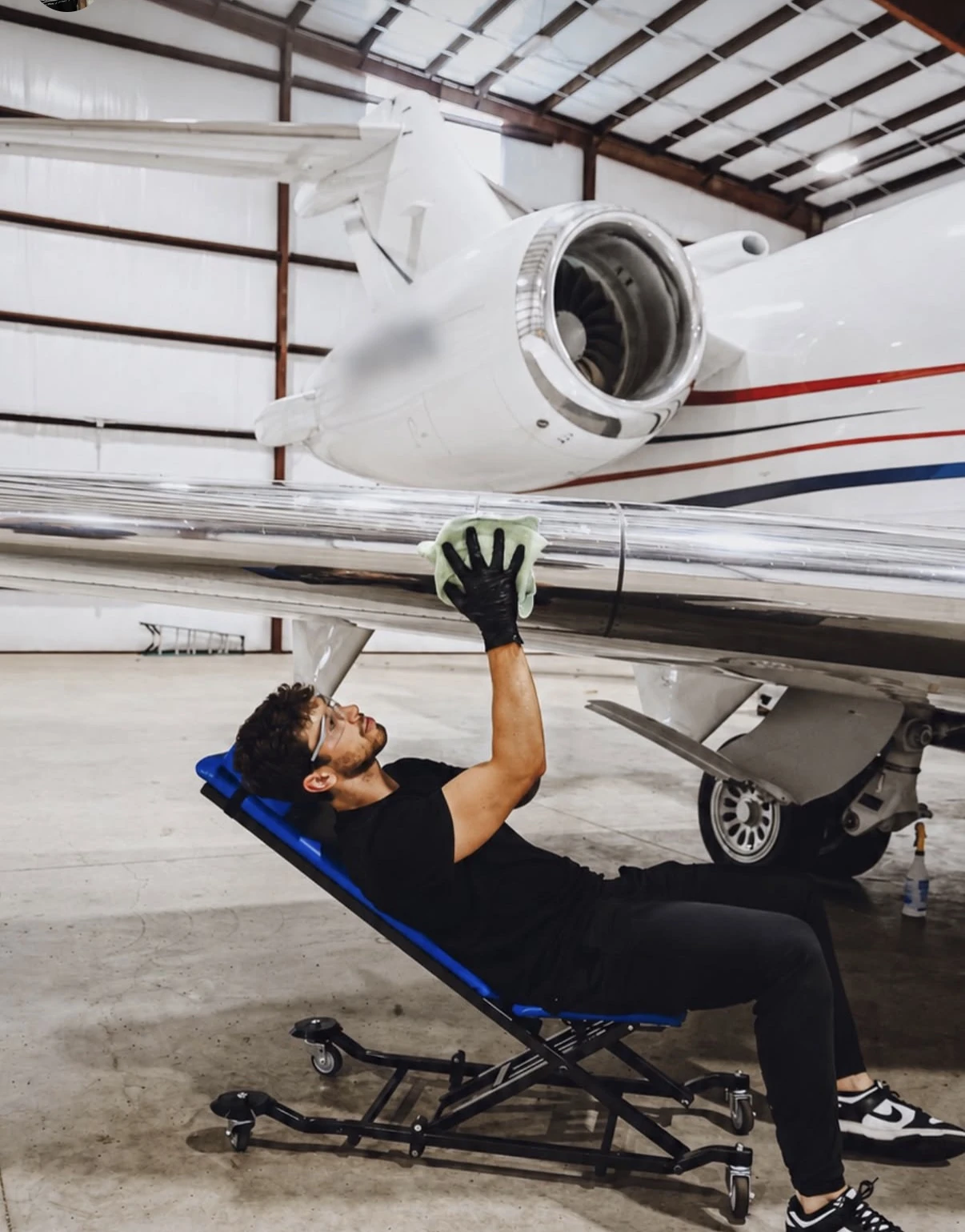
Detailing gets filed under “nice to have” on a lot of ownership budgets. The FAA disagrees. Cleaning the aircraft and simple preservation work — washing and protecting surfaces — appear in 14 CFR Part 43, Appendix A(c), the regulation’s own list of preventive maintenance. That classification isn’t trivia; it’s a signal about what this work actually does for an airframe.
Why the FAA calls cleaning maintenance
Preventive maintenance is work that preserves airworthiness and prevents deterioration — and surface care fits squarely inside that definition. Contaminants left on an airframe aren’t static: exhaust soot and hydraulic film are chemically active, grime holds moisture against seams and fasteners, and a neglected surface deteriorates in ways that eventually stop being cosmetic. Regular, correct cleaning interrupts that process. That’s maintenance by any definition, and the regulation treats it accordingly.
Where DIY and shortcut cleaning go wrong
The regulation classifies the activity — it doesn’t make every version of it safe. Most of the detailing damage we’re called to correct traces back to three shortcuts:
- Wrong chemicals. Automotive and hardware-store products strip aviation paint systems, corrode brightwork and permanently cloud acrylic windows. Every surface on an aircraft has a right chemistry, and most consumer products aren’t it.
- Wrong washing technique. Water driven into seams, static ports and control surface gaps sits where it can’t be seen — and corrosion loves nothing more. How and where water is applied matters as much as the soap.
- Wrong polishing. Aluminum brightwork and painted surfaces both have finite material to give. Aggressive compounds and heavy-handed machine work remove more than oxidation; done badly, polishing weakens what it was meant to preserve.
The inspection benefit nobody prices in
There’s a second, quieter value in professional detailing: proximity. A detailing team spends hours with its hands on every panel of the aircraft — closer and longer than almost anyone else between scheduled inspections. Early-stage corrosion, a failing seal, a hydraulic weep, a pneumatic boot starting to check: these get noticed and flagged while they’re still small line items. We’re not mechanics and don’t pretend to be — but “you should have someone look at this” from a detailer has saved more than one owner an expensive surprise at annual.
The financial case
Run the timeline out and the economics are straightforward. Paint that’s washed correctly and protected from UV goes years longer between corrections and a decade-plus between repaints. Brightwork that’s maintained never needs heroic restoration. An interior that’s cleaned and conditioned on schedule pushes refurbishment far into the future. Each of those deferred events is a five- or six-figure line item on an ownership budget — moved years further away by work that costs a fraction of any one of them.
The takeaway
Treat detailing the way the FAA classifies it: preventive maintenance, on a schedule, done by people who know what each surface needs. That’s the standard our full service menu is built around — aviation-safe products, correct technique for every material, and a finish inspected before we call it done.